How to World Build for a Novel: A Complete Guide for Every Type of Writer

Do you build your world before you write? During? After? The answer depends on how you write. This guide breaks down a proven worldbuilding framework for both plotters and pantsers. The most common mistake writers make is treating worldbuilding as something that happens before the story. In reality, it's an ongoing process — one that evolves as your characters, plot, and themes develop. There is no single "right" time to worldbuild. There's only the right time for you.
How to World Build for a Novel: Plotters vs. Pantsers
Your approach to worldbuilding should reflect your approach to writing. Most writers fall into one of two camps: plotters (who plan extensively before drafting) and pantsers (who discover the story as they write). Here's how each type can approach worldbuilding effectively.
Plotters: Build the Foundation First
If you're a plotter, you love having a plan. You want to understand your world — its history, geography, factions, and rules — before you write Chapter One. That's a huge advantage. But it comes with a risk: Worldbuilder's Disease, the trap of endlessly building your world instead of writing your book.
The solution: worldbuild the big stuff during your plotting phase, and leave the details for later.
Focus your pre-writing worldbuilding on what your story absolutely depends on — your "worldbuilding meta". This includes:
- Genre and tone
- Scope and geography
- Major world events that drive your plot
- Core systems your characters interact with (magic, technology, politics)
Write these ideas down now — even a few sentences per concept. They're the solid foundation your plot is built upon, and you'll need them on hand when you start drafting scenes.

Plotters During Draft One: Show, Don't Tell Your World
Once you start writing scenes, something shifts. You begin to experience your world through your characters' eyes — and the sensory details come alive. Instead of noting "the empire is authoritarian," you write the man in the stocks who couldn't pay his tithe.
This is worldbuilding too — and it's some of the most powerful kind. As you draft, capture these discoveries. Some writers add new world details to their world bible at the end of each writing session. Others do a dedicated "worldbuilding pass" once the first draft is complete, rereading the manuscript and documenting everything they invented along the way.
Either approach works. The goal is consistency: a world that feels coherent, immersive, and alive across every chapter.
Pantsers: Discover Your World as You Write
If the idea of plotting your world before you write sounds like a creativity killer, you're probably a pantser. You prefer the excitement of discovering your story in real time — and that's a completely valid (and often wildly productive) way to write.
For pantsers, the key to worldbuilding is using your characters as a lens. Every character is a window into your world. Ask yourself:
- Where were they born, and what was that place like?
- What traditions do they follow — or actively rebel against?
- What do they think of their government, their religion, their home?
- What details of daily life do they take for granted?
Each answer is worldbuilding gold — and it emerges organically from your story. The approach is sometimes called "Pantsing with Purpose": you're still following your instincts, but you're capturing your discoveries as you go.
The critical habit is documentation. People, places, creatures, technologies, customs — write them down as they appear. Nothing is too small. The weird detail you invented at midnight might become load-bearing lore by book three.
Worldbuilding Beyond the First Draft
Finishing a first draft is a genuine achievement — but it's not the end of your worldbuilding journey. Whether you plotted meticulously or discovered everything on the page, revision is another opportunity to deepen your setting.
This is the stage where you'll notice the gap between the world in your head and the world on the page. You know the palace smells of cinnamon — but did you ever write that? Your readers don't have access to your imagination. If a detail isn't on the page, it doesn't exist for them.
Revision is also when your first readers or alpha readers will flag worldbuilding inconsistencies and plot holes. A well-maintained world bible — whether in a dedicated app or a simple document — lets you search for the canonical truth of your world and resolve contradictions without breaking your setting.
By the time you reach line edits, your worldbuilding should feel solid. More importantly, it should be documented clearly enough that you can pick up book two without losing a single detail.
Key Worldbuilding Principles for Novelists
Regardless of your writing style, a few principles apply to every novelist learning how to world build for a novel:
- Start with what the story needs. Don't build a world — build the parts of a world your plot depends on. Expand outward from there.
- Document as you go. Memory is unreliable, especially across a multi-book series. Keep a world bible from day one.
- Show your world through character experience. Readers learn about your world the same way your characters do — through action, sensory detail, and consequence.
- Let your world evolve. Each draft will change your setting. That's not a problem — it's the process. Great worldbuilding is organic, not fixed.
- Avoid Worldbuilder's Disease. Worldbuilding is in service of your story, not the other way around. If you've been building for months without writing a single scene, it's time to start drafting.
Build Your Novel's World with World Anvil
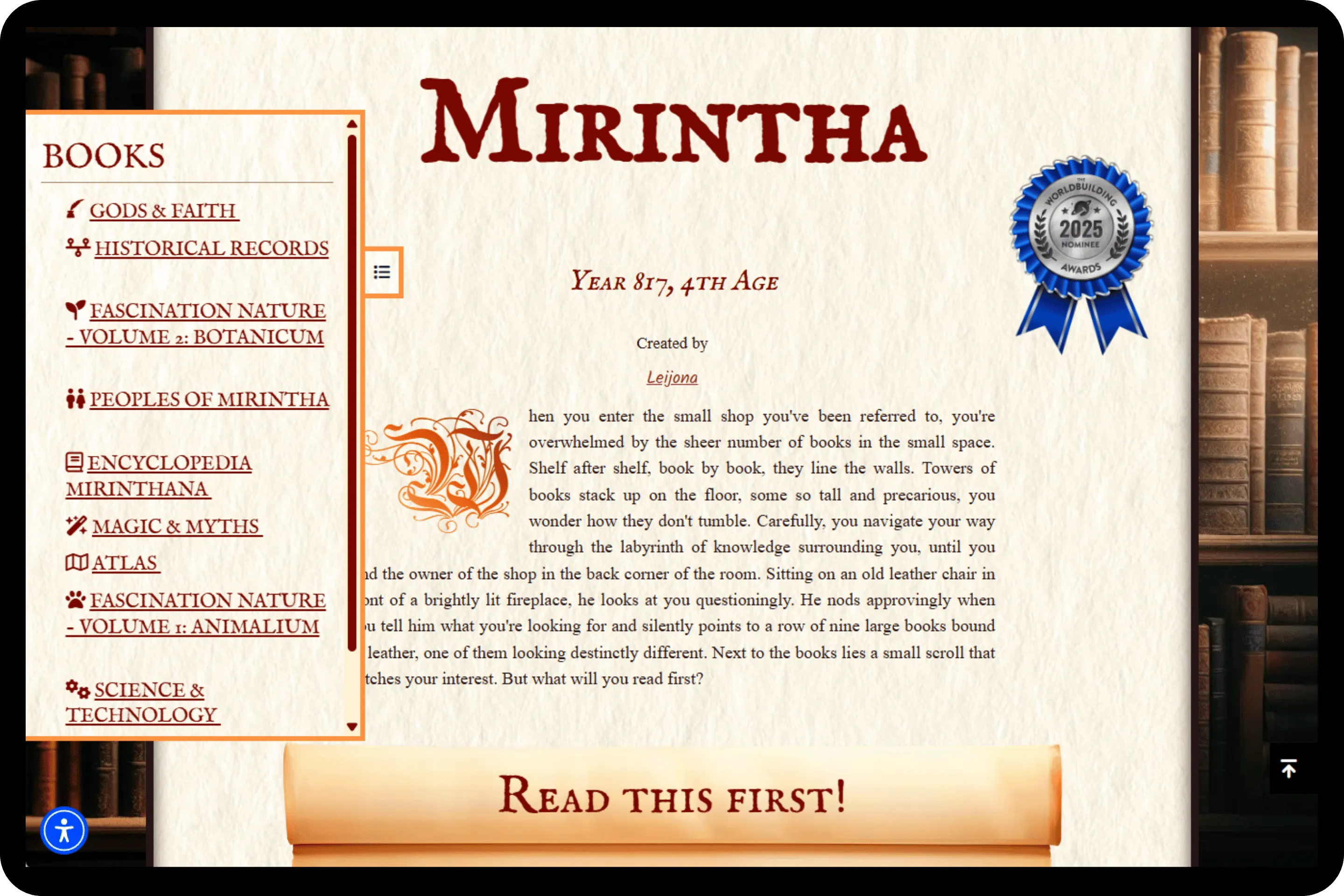
World Anvil is the award-winning worldbuilding and novel writing platform used by thousands of authors, game masters, and creative writers worldwide. It's designed to make the worldbuilding process faster, more organised, and more fun — so your world grows alongside your story, not in spite of it.
With World Anvil, you can:
- Document every detail of your world using purpose-built templates for locations, characters, religions, magic systems, species, and more
- Connect your articles automatically, so your world bible stays organised even as it grows
- Visualise your world with family trees, timelines, and interactive maps
- Write your novel directly inside the platform, with your world reference always one click away
- Keep your lore consistent across a series — no more contradictions, lost notes, or forgotten details
Create your free World Anvil account today and start building the world your novel deserves.
The Bottom Line: Worldbuilding Is a Process, Not a Phase
Should you worldbuild your novel setting before you write? The honest answer is: yes and no.
Worldbuilding is not a box you tick before the "real" writing begins. It's a living process that evolves with every draft, every scene, every character decision. Plotters will build more upfront; pantsers will discover more in the draft. But both approaches lead to the same destination: a rich, consistent, immersive world that makes readers forget they're reading fiction.
Start big if you're a plotter. Discover as you go if you're a pantser. But whatever your style, keep your world growing — because great worldbuilding doesn't just make your novel more interesting. It makes it feel real.

Learn worldbuilding methods & storytelling techniques from World Anvil experts to level-up your next novel, original D&D campaign setting or other creative projects.
.png)

Popular articles


Become a World
Anvil member
.webp)