How to Write Subplots (And How They Make Your Novel Better)

Sub plots are one of the most powerful tools in a novelist's kit, but they're also one of the trickiest to get right. You want to add richness; not rambles. So let's break down what sub plots are, why your fantasy book needs them, and how to juggle multiple plotlines without losing your mind (or your readers).
Whether you're drafting your first novel or you're deep into a sprawling multi-book series, you've probably felt it: that nagging sense that your main plot needs more. More texture. More tension. More reasons for readers to stay up until 2am turning pages.
That's where sub plots come in.
A well-crafted sub plot doesn't just pad your word count. It deepens your characters, raises the emotional stakes, and makes your fictional world feel lived-in and real. But balancing multiple storylines is a real craft challenge. In this guide, we'll walk you through everything you need to know about writing brilliant sub plots that keep readers hooked.
What Is a Sub Plot?
At its simplest, a sub plot is any storyline in your novel that runs alongside (and in service of) your main plot which is often called "the A plot."
Think of your main plot as the spine of your story. Sub plots are the ribs: they give the structure shape, strength, and room to breathe. They may follow secondary characters, explore thematic elements, or track your protagonist's inner journey while the external adventure unfolds.
A common shorthand you'll hear in writing circles:
- A plot = the main external storyline (defeating the villain, solving the mystery, completing the quest)
- B plot = a major secondary storyline, often tied to character relationships or internal conflict
- C plot (and beyond) = smaller threads that add depth and complications
The key idea? Every sub plot must serve the A plot, or earn its place by showcasing your central themes.

Why Bother With Sub Plots?
"Can't I just tell the main story and be done with it?"
You could. But your novel would feel thin and overly simplistic. It would also more likely fit within the word count and scope of a novella, which typically lack subplots. In real life, multiple things are always happening at once, and subplots help your novel feel more like reality. A well-deployed sub plot can:
- Deepen your characters by showing us who they are in quieter moments
- Add thematic resonance by exploring your story's central questions
- Raise the stakes by creating new complications and time pressures
- Provide pacing variety offering relief between high-tension moments
- Set up twists and payoffs for later in the story (or provide resolution in a series where the main plot won't resolve by the end of the book)
- Highlight your worldbuilding by showing us how your world functions beyond the heroes' immediate experience
For fantasy and sci-fi writers in particular, sub plots are a gift: they let you reveal the history, cultures, and politics of your world organically, without resorting to clunky exposition.
The 6 Most Common Types of Sub Plot
1. Romantic Sub Plot
Even in genres whose primary concerns are far removed from romance, like epic fantasy, space opera, or urban fantasy, a love story adds emotional stakes. Will they get together? Will the timing be terrible? Will the relationship survive the main plot's demands?
Romance sub plots also inform character development: how a character behaves when they're falling in love reveals a great deal about who they really are.
2. Character Arc Sub Plot
This is the internal journey of your protagonist (or a key secondary character). It's the emotional, psychological, or moral transformation that runs beneath the surface of the external plot. Often framed as the difference between what your character wants (external goal) and what they need (internal truth).
In stories with ensemble casts, each major character may have their own arc sub plot.
3. Mirror Sub Plot
A mirror sub plot runs parallel to the main plot but reflects it through a different lens. The most common version is the villain's arc as a dark mirror to the hero's. They face similar challenges but respond in opposite ways, highlighting your themes and making your antagonist feel genuinely three-dimensional.
Mirror sub plots are also a fantastic tool for thematic reinforcement. If your main plot is about "the cost of ambition," your mirror sub plot might show a secondary character who abandons ambition, and what they gain or lose as a result.
4. Stakes-Raising Sub Plot (The Ticking Clock)
Sometimes you need to pile more pressure onto your protagonist. A threat that will arrive regardless of whether the main plot resolves is a great way to do this. It might be a secondary character in danger. A secret about to come out. Or a rival closing in. These create urgency that feeds keeps readers flipping pages.
5. Non-Linear / Flashback Sub Plot
Backstory delivered as a properly structured sub plot with its own beginning, middle, and ending can be devastating. Used skilfully, flashbacks build dread, context, and emotional payoff for present-day events. The key is that flashback sequences should function as mini-stories in their own right, not just information dumps.
6. Framing Device Sub Plot
Frame narratives are where a story is presented as being told by or to a character in the "present," looking back. These create their own sub plot layer. Think Frankenstein, The Princess Bride, or Interview with the Vampire. The frame shapes how we interpret everything inside it.
How Many Sub Plots Does Your Novel Need?
There's no magic number — and anyone who tells you otherwise is selling something.
A tight cyberpunk thriller might need only one strong B plot. An epic fantasy series might require a dozen carefully interwoven storylines across multiple volumes. The right answer is: as many as your story genuinely requires.
The danger signs that you have too few sub plots:
- Your story feels one-dimensional or emotionally flat
- Secondary characters feel like furniture rather than people
- Your pacing drags because the main plot has no variation
The danger signs that you have too many:
- Readers lose track of what's happening and why they should care
- Sub plots disappear for long stretches and feel abandoned
- The main plot loses momentum because it's constantly competing for attention
A good rule of thumb for the initial draft or outline in novel-length fiction: aim for one strong B plot and one or two lighter C plots. You can always add more as your story demands. Or as your confidence with juggling storylines grows.
The Dos and Don'ts of Writing Sub Plots
✅ DO: Connect every sub plot to your main plot or central theme
A sub plot that can be removed entirely without affecting the main story isn't a sub plot. It's a tangent. Every secondary storyline should either complicate the main plot, highlight the theme, or develop a character who matters to the central story.
✅ DO: Give each sub plot its own structure
Sub plots aren't just mood or atmosphere. They need a beginning, a middle, and an end. Your romance sub plot needs to build, complicate, and resolve (or deliberately not resolve, if that's your intention). Your villain's arc needs its own escalation and climax. Think of each sub plot as a short story nested inside your novel.
✅ DO: Let sub plots intersect and complicate each other
The magic of great multi-plotline fiction isn't that the storylines run neatly parallel. It's that they collide. A decision made in the romance sub plot should ripple into the main plot. A revelation in a flashback sub plot should reframe the present-day. When your sub plots are woven together well, your story gains the kind of texture that makes readers feel the world is real.
❌ DON'T: Let sub plots disappear for too long
If readers are invested in a sub plot, going fifty pages without a mention of it breaks the spell. This is one of the most common mistakes, and one of the hardest to spot while you're writing. After all, you know what's coming. During revision, track each sub plot and make sure it has a consistent presence.
❌ DON'T: Confuse sub plots with backstory or worldbuilding
Backstory and worldbuilding are setting. Sub plots are structure. The history of your magic system isn't a sub plot, unless your protagonist (or his mentor) helped develop it. The character's difficult childhood isn't a sub plot, unless something gained or lost from that experience is actively relevant in today's conflict.
❌ DON'T: Forget to pay off what you set up
Every sub plot is a promise. If you open a romantic thread in chapter two, readers will expect it to go somewhere. If you hint at a secondary character's secret, it needs to matter when it's revealed. Chekhov's gun applies to your sub plots just as much as your main plot.
How to Track Multiple Sub Plots (Without Losing Your Mind)
Here's the thing about juggling multiple storylines: your brain is not a reliable filing system. The moment you're deep in chapter eighteen, you will forget that you left a crucial sub plot dangling since chapter nine. You need external tools.
Color-Coding Your Manuscript
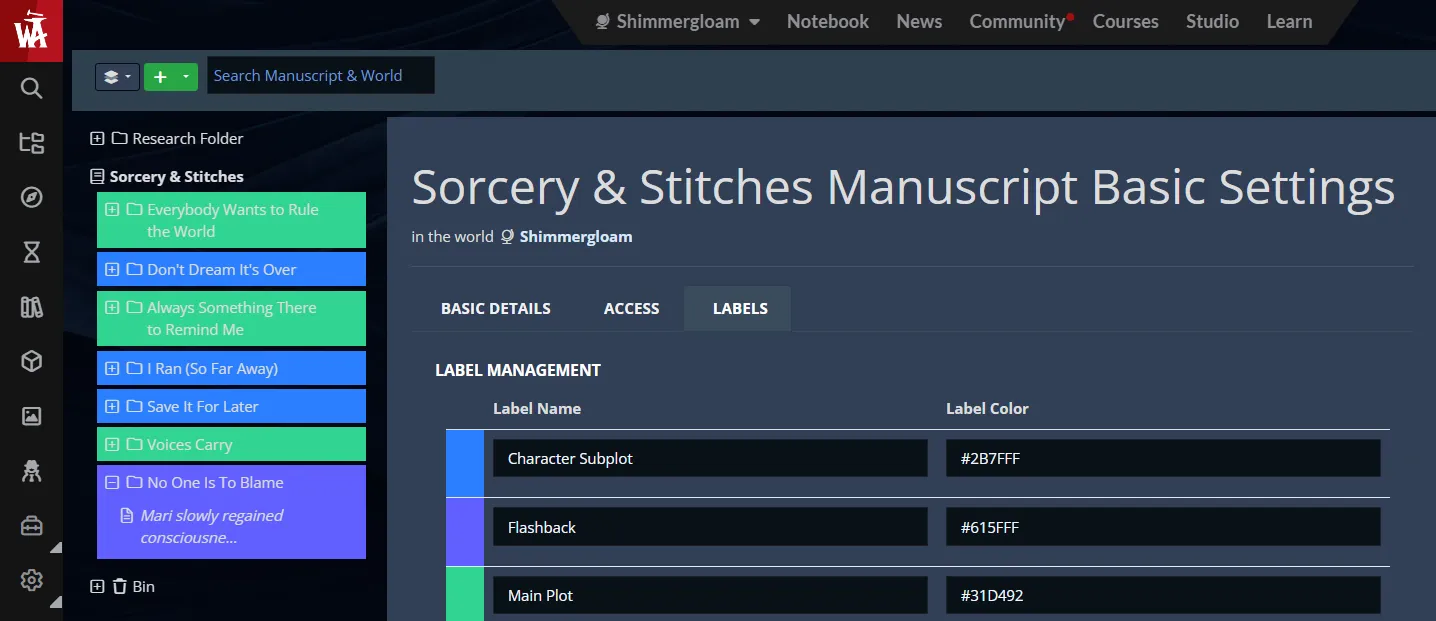
Many writers assign each plotline a colour and then highlight their manuscript accordingly. This makes it easy to see at a glance which sub plots are well-distributed and which are mysteriously absent for eighty pages at a stretch. In World Anvil's Manuscript feature, you can use labels to color code each scene or chapter.
Using Timelines to Visualise Your Plotlines
One of the most elegant ways to manage multiple sub plots — especially in stories with complex chronologies, multiple POV characters, or events unfolding across a large world — is a timeline tool.
A visual timeline lets you lay out every storyline as a horizontal track, see where they intersect or diverge, and spot structural problems before they become revision nightmares. This is especially valuable for:
- Series writers tracking which sub plots span multiple books
- Multi-POV stories where different characters experience the same events from different angles
- Non-linear narratives where flashback sub plots need to be precisely sequenced
- Worldbuilders whose sub plots involve political events, wars, or histories unfolding across the whole world
This is exactly where World Anvil's Timeline feature becomes indispensable.
Track Your Sub Plots with World Anvil Timelines
World Anvil is the world-building and novel-writing platform built for exactly this kind of complexity. The Timeline feature lets you create multiple parallel timelines for your story: one per plotline, per POV character, or per storyline strand. And view them all together in one visual interface.
Imagine being able to see your romance B plot, your villain's arc, and your protagonist's internal journey all mapped out side by side, with every key story event pinned in place. For writers working on series, this becomes even more powerful. You can create timelines that span multiple books, tracking long-running sub plots across an entire saga. The slow-burn romance that pays off in book three, the political conspiracy that's been seeding since book one. Nothing gets lost, nothing gets forgotten.
And because World Anvil keeps all of your world-building, characters, locations, and plot notes in one place, your timelines don't exist in isolation. They're connected to the whole living fabric of your fictional world.
💡 Pro tip: Create one timeline per major plotline (A plot, B plot, C plot), then use World Anvil's timelines to see them all together. At a glance, you'll see exactly where your sub plots are working, and where they need attention.
Sub Plots in a Series: A Special Challenge
If you're writing a multi-book series, sub plots take on extra layers of complexity. You're not just managing storylines within one novel. You're managing promises that span hundreds of thousands of words and potentially years of a reader's life.
The most common series sub plot mistakes:
- The abandoned thread: a sub plot from book one that simply never appears again in book two or three
- The forgotten setup: a hint or foreshadowing that the author clearly forgot to pay off
- The rushed resolution: a long-running sub plot that suddenly wraps up in two pages because the writer ran out of space in the final book
The solution is rigorous planning and documentation. Exactly what World Anvil is built for. Check out our guide to plotting a novel for more on structuring your main plot before you layer sub plots on top.
You might also find our article on story hooks, conflict, and antagonists useful when it comes to giving your sub plots genuine stakes.
Quick Sub Plot Checklist
Before you finalize your novel's structure, run each sub plot through this checklist:
- Does this sub plot connect meaningfully to the main plot or central theme?
- Does it have a clear beginning, middle, and end?
- Does it develop a character who matters to the main story?
- Does it appear consistently throughout the novel (not just at the start and end)?
- Does it intersect with at least one other storyline?
- Does it build to a payoff that rewards the reader's investment?
If you can tick all six boxes, you have a sub plot that's genuinely earning its place.
Ready to Organize Your Plotlines?
Writing a novel with rich, well-structured sub plots is one of the most satisfying creative achievements there is. But it requires organisation, planning, and the right tools. Especially as your story grows in complexity.
World Anvil gives you everything you need in one place: timelines to map your plotlines, character articles to track your cast, world-building tools to build out the setting your sub plots live in, and a structure that scales from a standalone novel all the way to a ten-book epic fantasy series.
Create your free World Anvil account today and start mapping your sub plots before they get away from you!

Learn worldbuilding methods & storytelling techniques from World Anvil experts to level-up your next novel, original D&D campaign setting or other creative projects.
.png)

Popular articles


Become a World
Anvil member
.webp)