How to Build a D&D Campaign Wiki: A Complete Lore Management System

Your campaign has been running for six months. Your players are deep in your homebrew world, and you've built something special. Then a player asks: "What was the name of that tiefling merchant we met in the border town, back in session four?"
And you have absolutely no idea.
You dig through your notes. There are three Google Docs, a collection of sticky notes, your spiral-bound notebook, and the creeping certainty that whether you actually wrote that down or not, you're not finding it this session. So you make something up on the spot you'll just have to retcon later.
This is the problem a campaign wiki solves. Not by creating more notes, but by creating better structure. If you've been running your world out of folders and good intentions, this guide will give you the architecture to fix it, and keep it fixed through years of play.
What Is a Campaign Wiki?
A campaign wiki is a cross-referenced, searchable knowledge base for your world: a system where every NPC links to their faction, every faction links to their city, every city links to the history that shaped it.
The key word is linked. A folder of documents is a filing system. A wiki is a living network. The difference in play is enormous: instead of hunting through files, you follow a thread.
This matters especially at the table. When a player does something unexpected—invoking a contact they met three arcs ago, or trying to leverage an old grudge between two factions—you need to find information fast. A wiki makes that possible. A folder of docs does not.

Do You Actually Need One?
A campaign wiki earns its setup time if any of the following are true:
- You're running a homebrew setting, not a published module
- Your campaign is past session ten and still going
- Players regularly ask lore questions between sessions
- You want to share parts of your world with players without accidentally sharing your DM notes
- You've ever lost a piece of information you wished you still had
If you're running a three-session one-shot, a wiki is overkill. For anything longer, it's one of the best investments you can make in your own prep.
The Five Layers of a Campaign Wiki
A complete campaign wiki isn't one thing. It's five, each with a different purpose, a different update cadence, and a different audience.
Layer 1: World Lore (Your Foundation)
This is the bedrock: geography, cosmology, history, religions, factions, and the rules of your magic system. World Lore is written once and updated rarely. It's the "this is always true" layer; the facts your world relies on whether or not the players ever discover them.
Examples: the origin story of the gods, the political boundaries of your major powers, the cost structure of your magic system, why the last empire fell.
The temptation here is to write everything before you start. Resist it. Sketch the foundations you actually need, flag the questions you haven't answered, and let the rest grow organically as play demands it.
Layer 2: Living People (NPCs and Factions)
This layer tracks the characters who populate your world: individual NPC profiles, faction structures, and the relationships between them.
The critical habit here is tracking what an NPC knows separately from what the party knows. Those are two completely different documents. An NPC might know the identity of the mole in the thieves' guild; the party might not. Your wiki should reflect that gap so you never accidentally tip your hand.
Update this layer whenever a session meaningfully changes an NPC's status, loyalties, or relationship with the party.
Layer 3: Places (Locations and Maps)
A hierarchy of place articles moving from the macro to the micro: world map, regional map, city level, dungeon level. Each location article carries its own atmosphere description, notable features, resident NPCs, and any connected plot threads.
The real power here is when your map links directly to your articles. When a player asks "what's in the Thornwood?" you click the Thornwood on your map and everything you've written about it is right there. Interactive maps that connect to location articles are one of the most underrated prep tools available to DMs. They make exploration feel genuinely discoverable rather than scripted.
Layer 4: The Timeline (History and Campaign Events)
Two parallel timelines run through any long campaign. The first covers world history such as the events that happened before your players arrived. The second tracks campaign events session by session, the record of what your players actually did and when.
The timeline is also your GM planning surface. What are the villains doing while the party isn't watching? What event is coming whether or not the players intercept it? A living timeline stops your world from feeling like it only exists when the party shows up. Which is called Snow Globe Worldbuilding, and players notice it more than you think.
Layer 5: Session Notes (Your Active Play Layer)
This is the only layer that's primarily for you, not for reference or player-facing use. Session notes have three phases:
Pre-session: encounters planned, NPCs to feature, hooks to dangle, loose threads to pull.
During-session: quick capture of names, dice results, player decisions, anything you'll need later. This doesn't need to be clean. It needs to exist.
Post-session: translate the chaos of your during-session notes into clean updates across Layers 1–4. This is the 15-minute habit that keeps your wiki alive (more on this later).
Article Templates for Each Layer
Good templates do two things: they prompt you to capture what matters, and they ensure every article of the same type is structured the same way, which makes finding things faster.
Here are the core templates you'll actually use.
Character Template (NPC)
- Name, pronouns, role/occupation
- Affiliation (faction, location, employer)
- Physical description keep it to two or three details: the things your players can see from across a tavern
- Personality two or three words, plus one distinguishing speech pattern or verbal tic
- Motivation what do they want, and why?
- Secret what are they hiding, and from whom?
- Relationship to party ally, neutral, antagonist, or complicated
- Current status alive, dead, missing, transformed, imprisoned
- Last seen when and where
Location Template
- Name, region, type (city, dungeon, wilderness, planar)
- One-sentence atmosphere "feels like..." works well here; give yourself a mood in seven words
- Key features three to five bullet points
- Resident or associated NPCs linked to their articles
- Connected quests or plot threads
- DM notes hidden from players, flagged clearly
Organization Template (Factions)
- Name, type (political, religious, criminal, arcane, mercantile)
- Public goal vs. secret goal these should be different
- Key members linked to NPC articles
- Resources and reach what can they actually do?
- Relationships to other factions allies, rivals, neutral parties
- Party engagement paths how can your players work with, against, or around them?
Session Note Template
- Session number + in-world date
- Where the party started and ended
- Key decisions made
- NPCs introduced or meaningfully changed
- Loose threads to follow up
- Post-session wiki updates needed: run this as a checklist you tick off before next session
The Linking System: What Makes a Wiki Actually Work
You can fill out perfect templates and still end up with a system that's just a prettier folder. The difference is links.
The one-write rule. Every NPC, place, and faction gets one canonical article. Everything else points to it. You never duplicate. If Mira the fence appears in your session notes, your city article, and your thieves' guild article, each of those references links to Mira's NPC article. They don't copy her information. The moment you start copying, your notes get out of sync, and out-of-sync notes are worse than no notes.
Bidirectional linking. If Mira's NPC article links to the Shadowhand guild, the Shadowhand guild article should list Mira. Linking in one direction only creates dead ends you won't find at the table.
Tags and categories. Develop a consistent taxonomy early and stick to it. At minimum, categorize by region, by campaign arc, and by status (active, inactive, dead, unmet). This lets you filter and search rather than browse.
The player-facing layer. One of the most powerful things a campaign wiki enables is showing players some of it. Not your DM notes, but location descriptions, faction summaries, lore they've discovered, NPCs they've met. This transforms your wiki from a private DM tool into a collaborative world document. Players who can reference the wiki between sessions come to the table better engaged and ask better questions.
Choosing a Tool
The five-layer structure above can be built in almost any wiki tool. What separates the good options from the frustrating ones is how well they handle the specific needs of campaign management.
When evaluating a tool, the questions to ask are: Does it support internal linking? Can I control what players see vs. what stays DM-only? Does it have templates for the kinds of articles I'm writing? Can I attach a map and link it to my articles? And does it have somewhere I can take session notes in the same place?
General-purpose tools like Notion or Google Docs handle some of these well. But they require significant setup, and they don't have visibility controls designed specifically for the GM/player dynamic.
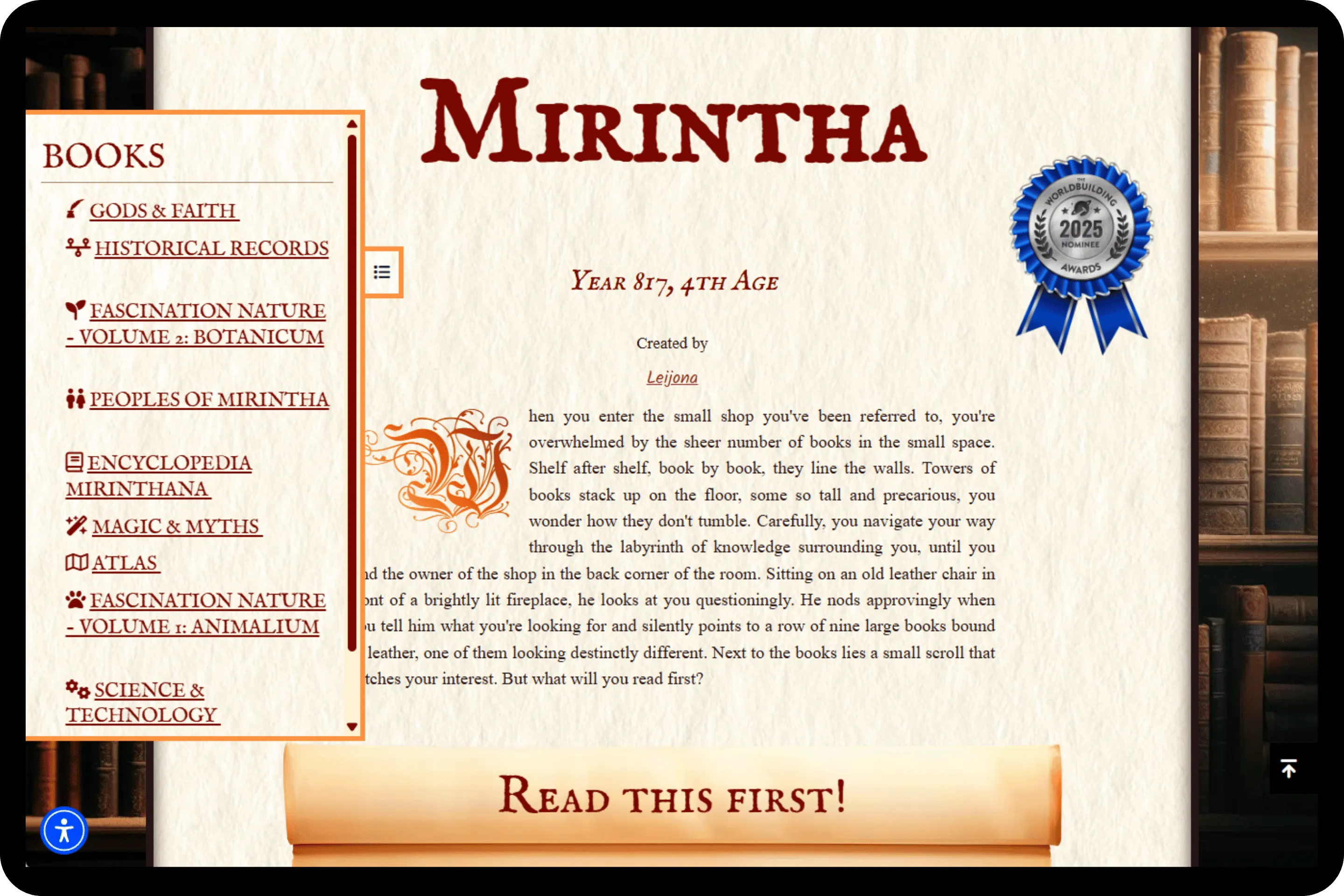
World Anvil is built around exactly this problem. The article templates are pre-structured for the kinds of things DMs actually need to track: NPCs, locations, factions, timelines, organizations. The visibility system lets you mark entire sections of an article as DM-only, so you can share your world with your players without accidentally revealing that the friendly blacksmith is working for the villain. And the interactive map module links pins directly to location articles, which is the single feature that most transforms the exploration layer of campaign management.
If you're starting from scratch, or if you've been fighting a tool that wasn't built for this, it's worth trying something designed specifically for the work.
Keeping Your Wiki Alive Through a Long Campaign
Most campaign wikis die in month three. DMs build them enthusiastically, update them religiously for the first few sessions, and then slowly stop—usually because post-session updates feel like admin work after an already long evening.
Here's the system that prevents it.
The 15-minute post-session rule. Don't try to update everything after a session. Just work through your session note checklist: which NPCs need a status update, which location did something change in, which new thread appeared that needs a stub article. Cap yourself at 15 minutes. You're not writing essays—you're making sure nothing falls through the cracks.
Stub articles. When a new NPC appears during a session, create the article immediately, even if it's just a name and a single sentence. A stub you can flesh out later is infinitely more useful than a name in your session notes that you'll forget the context for by week two.
Use player questions as a gap detector. If a player asks a lore question you can't answer without searching for it, that's a wiki gap to fill. Every question your players ask is feedback about what your system is missing.
Share your world as motivation. This is underrated. Publishing parts of your world — even just to your players — reframes wiki maintenance from admin work into creative satisfaction. You're not updating a database; you're building something people are reading and enjoying. The motivation that keeps worldbuilders going is almost always an audience, even a small one.
A Note on Scope
The biggest mistake DMs make when building a campaign wiki isn't a structural one. It's a scope problem. They try to build the whole thing before session one. Two hundred articles covering every city, every god, and every historical era, none of which their players will ever touch.
Start with what you need. Build Layer 1 just enough to establish your world's foundations. Create Layer 2 articles only for NPCs who are about to appear. Stub out locations before you need them in detail. Let the wiki grow out of actual play, not before it.
A wiki with twenty well-linked articles that reflects your actual campaign is more useful than five hundred articles in a world your players haven't reached yet. The richness comes from depth, not from volume—and depth grows from the table, one session at a time.
The Takeaway
A campaign wiki isn't a place to store everything. It's a place to find anything.
The five layers of World Lore, Living People, Places, Timeline, and Session Notes give your information structure. The linking system turns structure into a network. The templates make maintenance fast enough to actually sustain. And the post-session habit is what keeps it alive.
Start small. Build one template article for an NPC your players are about to meet. Link it to their faction. Link the faction to a location. That's already a wiki. And it'll save you the first time a player asks about that tiefling merchant from session four.
Ready to build your campaign wiki? World Anvil's campaign management tools include pre-built article templates for NPCs, locations, factions, timelines, and more, with visibility controls that let you share your world with players without revealing your DM notes. Create your free account here.

Learn worldbuilding methods & storytelling techniques from World Anvil experts to level-up your next novel, original D&D campaign setting or other creative projects.
.png)

Popular articles


Become a World
Anvil member
.webp)