How to Publish Your Homebrew World: From Private Wiki to Shareable Setting
You've been building your world for months. Maybe years. Your campaign wiki is full of factions with competing agendas, NPCs with secrets, a history that explains why everything is the way it is. Your players love it. But only six people have ever actually experienced it, and that just feels... wrong.
Here's the thing: that gap between "this exists" and "this is published" feels enormous, but it isn't. Most worldbuilders never cross it not because their work isn't ready, but because they don't know what the path looks like. So that's what we're covering today: the journey from sharing your world with your players to releasing a product, and how to figure out which step is right for you now.
Let's get into it.
Before You Publish: The Readiness Check
First, let's talk about what "ready" actually means, because a lot of worldbuilders either underestimate how much they have, or convince themselves they need ten more years before anyone can see it.
You don't need a complete world. You need a coherent one. A setting with enough internal consistency that a stranger can orient themselves in it without you in the room explaining it. That's the bar.
The minimum viable setting has four things:
- A defined region
- Factions with competing goals
- Enough history to explain the present
- At least one compelling conflict
If you have those four things, you have something publishable.
Ask yourself three questions.
- Can someone understand your world without you explaining it? If every article needs a verbal footnote, it needs more work on the page first.
- Is there a hook? What makes your setting different from the published options already out there? You don't need to reinvent the genre, but you do need a clear answer.
- Who is this actually for? Players at your table, DMs who want to run your setting, readers who want to explore your lore, or people paying for a product?
One more thing before we go further: if your homebrew world contains elements derived from published settings, system-specific mechanics, or trademarked content, your publishing options are constrained. Get familiar with the OGL and Creative Commons landscape before you post anything publicly, and when you're in doubt, talk to a lawyer, not a Reddit thread.
The Publishing Pathway
Publishing a homebrew world isn't a single decision. It's a series of choices, each with its own effort level, audience, and reward. There are six steps, and they build on each other.
Step 1 is the player-facing wiki, and it's the step many DMs never take even though it's the most obvious one. You make parts of your private campaign wiki visible to your players. Location descriptions, faction summaries, NPC profiles without your DM notes, and lore they've already discovered at the table.
This matters more than it sounds. Players who can reference the world between sessions come to the table better prepared, ask better questions, and engage more deeply with the story you're building together. And the real valueis that it's the first time your world has to communicate without you. You'll find out very quickly what's clear and what isn't.
World Anvil's visibility controls make this straightforward. You can mark individual sections of an article as DM-only and share a public-facing version of your world with a single link. Your players see the world. They don't see your notes. And you keep everything in one place.
Step 2 is the public world page, which means making your world discoverable to the internet, not for sale, just visible. This is what worldbuilders do when they want feedback, community, accountability, and the satisfaction of an audience beyond their table.
What your public world page needs is an accessible entry point: a setting home page, a "start here" article or world primer, enough lore to hook someone who's stumbled across your world for the first time. And a clear sense of tone and genre. Someone should be able to tell within two minutes whether this is their kind of world.
One advantage of publishing on World Anvil specifically is that it has an existing worldbuilding community. Your public world gets discovered organically by people who are already interested in exactly what you're making. That's different from publishing into a void.
Step 3 is a free PDF or digital supplement, and it's a simple entry point to promoting your world beyond your table. A setting primer of ten to twenty pages. A regional guide. A faction sourcebook. A one-shot adventure set in your world. Free.
Free removes the barrier of "is this worth paying for" and lets you build an audience and confidence before you ask anyone to spend money. You'll also learn something invaluable: what format presents your world best. Some settings work as dense lore documents. Others need the structure of an adventure to land. A free release teaches you which one yours is. You can distribute through DMsGuild, itch.io, DriveThruRPG, or just post it in relevant Reddit communities.
Step 4 is a commercial release on a marketplace, which is the first step towards selling your work.
DMsGuild is the right choice if your setting is D&D-adjacent or uses official WotC settings and mechanics. It's a revenue share model, WotC takes a cut, but the audience is built-in and the discoverability is real. Itch.io is better for system-agnostic or indie-system content. Creator-friendly revenue terms, a strong indie TTRPG community, and no content restrictions tied to a specific system. DriveThruRPG is the broadest marketplace and works for almost any TTRPG content, but discoverability is harder for new releases without external promotion.
What commercial release requires that free release doesn't: professional layout, editing, and either original art or properly licensed art. These aren't optional at the paid tier. Readers will forgive a lot in a free PDF. They won't forgive it in something they paid for.
Step 5 is Patreon or a subscription model, which is a fundamentally different thing from a product launch. You're not selling a finished thing. You're building an ongoing creative relationship with supporters who fund your world as it develops. Monthly lore drops, maps, faction guides, session recaps, behind-the-scenes worldbuilding process, exclusive player content.
This works well for DMs and worldbuilders who already have an audience and want to fund ongoing development rather than ship discrete products. The critical requirement is consistency. Patreon lives and dies by your publishing schedule, not by the quality of any single post. World Anvil has Patreon integration built in, so you can gate specific world content for subscribers without needing a separate platform.
Step 6 is crowdfunding a setting book, a Kickstarter or Backerkit campaign for a printed or premium digital product. This is the full product launch, and it's also the most demanding by a significant margin. Kickstarter campaigns without an existing audience almost never fund. The work of building that audience happens in Paths 1 through 5, not on the campaign page. The Kickstarter is the harvest. Everything before it is planting and tending the garden.
If you're at the point where crowdfunding makes sense, what you need is a finished or near-finished product, a strong visual identity, a clear player and DM value proposition, stretch goals that expand the world rather than inflate the scope, and a realistic production timeline. The indie TTRPG campaigns that succeed have almost all spent months or years in public before they ever launched.
What Your Setting Needs Before It's Ready to Share
Regardless of which path you're taking, a few specific pieces of content need to exist.
The first is a setting primer: a one-to-three page document that answers the question "what is this world" for a complete stranger. Tone, genre, core conflicts, what makes it different. No assumed knowledge. This becomes the foundation of everything: your public world page, your DMsGuild description, your Kickstarter page, your Patreon welcome post. Write it first.
The second is an entry point article: the first piece of lore a reader encounters that makes them want to read the second. Usually this is a compelling location, a major faction, or a world-defining event. Not a geography overview. Think of it as your world's hook, not its table of contents.
If you're publishing something for other DMs to run, you also need a DM's guide: what does someone need to know to run this world confidently without you? Tone guidance, faction motivations, what the major conflicts look like at the table. This is the hardest document to write because it forces you to see your world as a stranger would. It's also the most valuable one.
And then there's art. For a commercial release, art and visual identity are the single most important production decision you'll make. Original commissioned art or licensed stock come with their own tradeoffs. Whatever you choose, visual consistency matters more than visual quality at the indie level. A coherent aesthetic at modest quality beats polished work that doesn't feel like it belongs to the same world.
How World Anvil supports worldbuilders.
If you're serious about building and publishing your world, our free worldbuilding course is the best place to start. It walks you through the foundations of creating a setting that holds together, whether you're running a campaign, writing a novel, or building toward a published product. It's completely free, and you can sign up at the link here.
Building Your Audience Before You Launch
The audience for your published world doesn't appear at launch. It builds in the months or years before it. Worldbuilders who launch successfully are the ones who've been sharing their process publicly long before they had a product to sell.
The platforms that work for TTRPG worldbuilders: the World Anvil community, Reddit communities like r/worldbuilding and r/DnD, TikTok and YouTube for worldbuilding process content, and Discord servers for specific game systems. What you share matters too. Lore excerpts, faction breakdowns, maps, session recaps, behind-the-scenes worldbuilding decisions, work-in-progress art. If you feel like asking people to buy your thing is gross, that's fine. But you do need to get comfortable sharing your work.
An audience built around your process becomes an audience ready to back your product. Give people a story to follow before you give them something to buy.
Putting It All Together
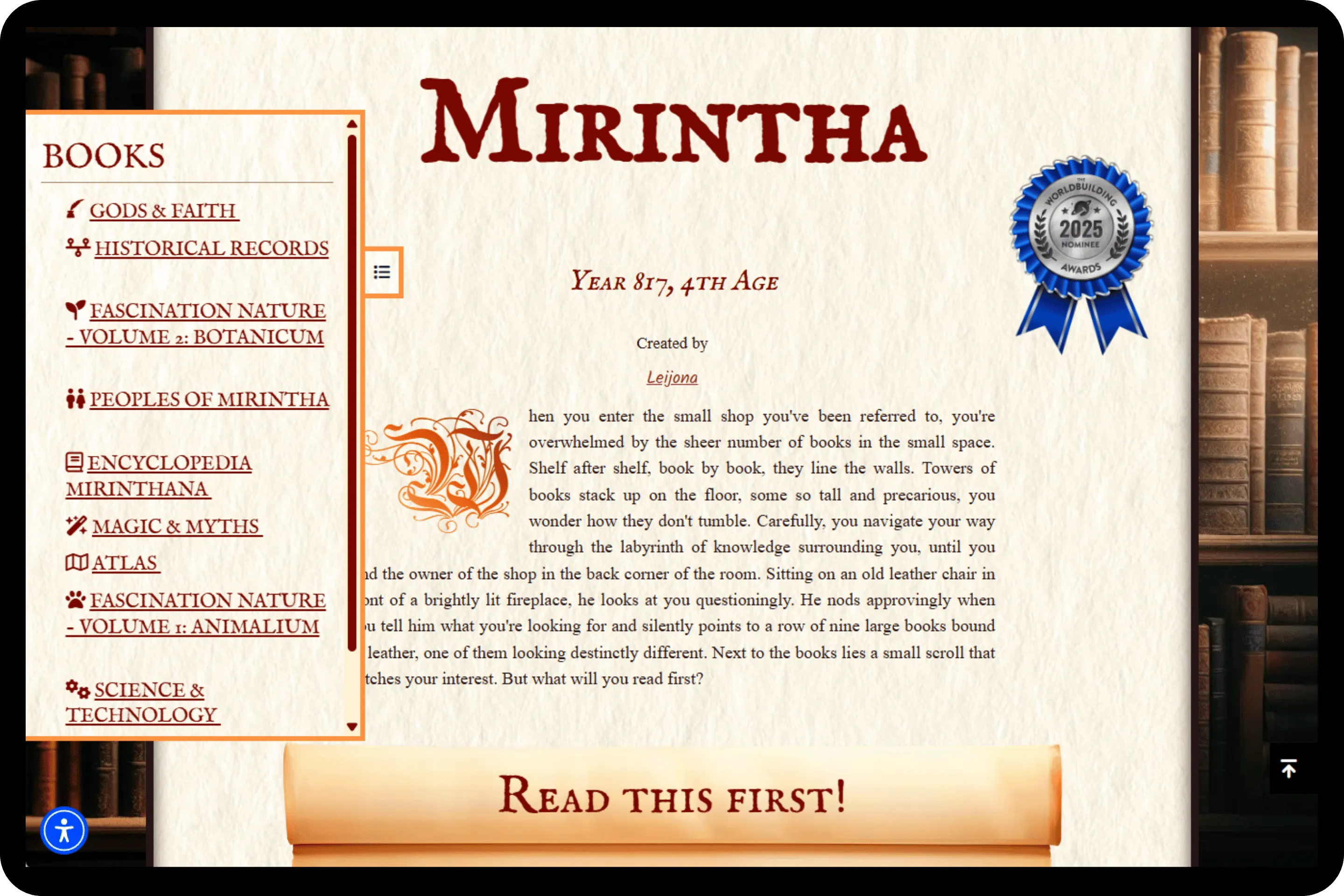
World Anvil's structure maps pretty cleanly onto this entire publishing spectrum, which isn't an accident. The same platform that holds your private campaign notes can serve as your player-facing wiki, your public world page, and the living companion to a published product.
You toggle visibility on individual articles, customize your world's landing page, export content when you're ready to move into layout, and link your World Anvil world page as the ever-expanding supplement to whatever ships in print or PDF. Published TTRPG settings use World Anvil as their official lore hub precisely because it handles every stage of the journey without making you change tools.
The Takeaway
Publishing your homebrew world doesn't mean writing a 300-page setting book. It means making one intentional step from private toward public. The worst outcome isn't a bad Kickstarter. It's a brilliant world that only six people ever experienced.
Start with Step 1 or 2. Make part of your world visible to someone who isn't at your table. That's the first act of publishing, and everything else grows from there.
And if you're looking for ways to make your world more compelling for the players who are already in it, we've got an article on the formula for irresistible D&D side quests. Side quests are one of the best tools you have for letting players discover the parts of your world you've worked hardest on, so it's worth a look.
Now grab your hammer, and go worldbuild!

Learn worldbuilding methods & storytelling techniques from World Anvil experts to level-up your next novel, original D&D campaign setting or other creative projects.
.png)

Popular articles

Become a World
Anvil member
.webp)