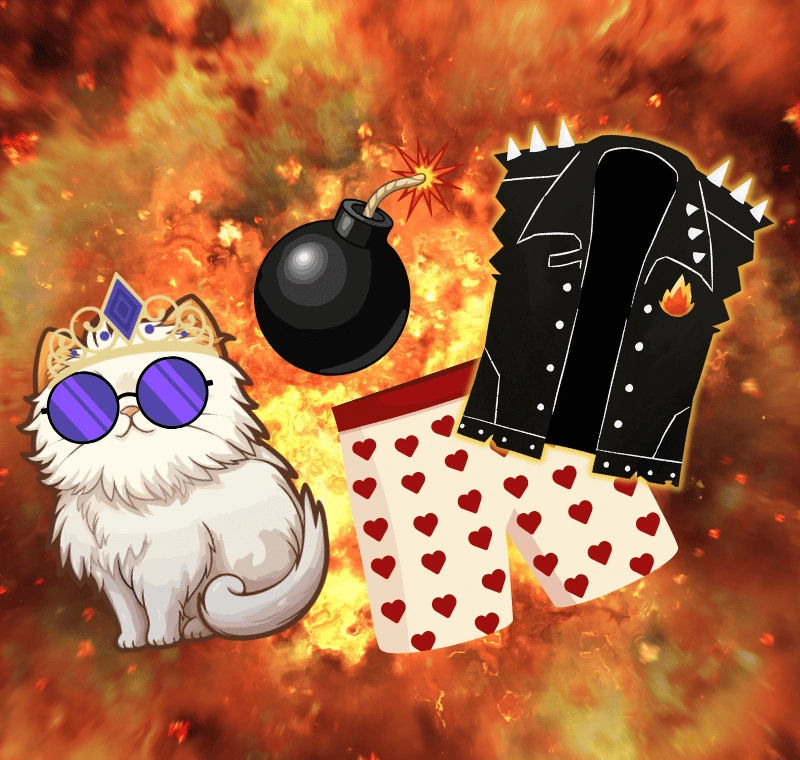
What do Elvis impersonators, tech-knights in power armour and a fascist Roman cosplay army have in common? As mad as it sounds, they all belong seamlessly in one beloved setting: the post-apocalyptic world of Fallout.
And those aren't even the wildest factions in the series. Which is your favourite? Tell us in the comments.
Fallout famously excels at factions. Each one has a vision of how the world ought to be, and that vision is inextricably linked to the history of the setting. In this article, we'll steal the secrets behind Fallout's factions so you can use them in your own worldbuilding, whether you're a dungeon master, an author, or just building worlds for fun.
What is a faction? Worldbuilding factions 101
First, a definition. In worldbuilding, a faction is a group united by a shared identity, belief or goal, with enough power to affect the world around them.
That last part matters. Factions want something and have the power to do something about it, which is what makes them such useful storytelling tools.
Look at Fallout. The New California Republic, the Brotherhood of Steel and Caesar's Legion aren't just clubs with different outfits. Each has a fundamentally different interpretation of what caused the apocalypse and what should replace the current status quo, which is, frankly, a mess of irradiated chaos. As each faction actively pursues its ideals, it makes the world move.
Put simply, factions create conflicts, alliances, enemies, plot hooks and missions. They make your setting feel alive in the background, even when your protagonists aren't doing anything at all.
For TTRPG Game Masters, factions also make the world react to your players. Help one faction and you might make an enemy of another. Murder your way through a headquarters and, congratulations, murder hobos, there are consequences.
Most importantly, factions create choices, and Fallout is particularly good at making those choices complicated.

So how do you create factions as intriguing and believable as Fallout's? Start here.
Tip 1: Worldbuild factions as a product of the world
The first secret is that your factions should be products of your world.
When Fallout: New Vegas director Josh Sawyer was asked about the game's factions, he said:
"We looked at organizations that would be appropriate for the region given Vegas history."
You can see that everywhere in the lore. Take the Kings, a gang operating out of an old Elvis impersonator school. They've misunderstood parts of what they've found, but they've built an entire identity around a mysterious pre-war figure they call "the King."
It's ridiculous, but it's also genius. It matches the comedy-horror vibe of Fallout and fits the core concept of the setting: post-apocalyptic Las Vegas.
When you're worldbuilding factions, resist the urge to reach straight for the standard tropes of your genre, like the thieves' guild or the cyberpunk gang. Dig into the specific history, geography and lore of your own setting instead, and ask: "What kinds of groups could only have arisen here?"
- If gods are real and important, expect religions, cults and holy orders to wield power.
- If magic is dangerous, perhaps organizations exist to control it, or destroy it.
- If your world revolves around trade, merchants, banks and criminal syndicates might be major political players.
This naturally creates factions fighting for change and power, and it puts story right at the centre of your lore.
Your factions can also be offshoots of other factions, ancient or modern. That grounds them in your world's own logic and builds in drama. Think of the Christian church: hundreds of sects from different centuries and regions, all descended from the same main organizations.
Keeping track of this is critical, because you can bet the people in your world do too. Use a content tree to trace the lineage of organizations through their iterations and splinters, so you're never left in confusion and your world feels authentically complex, in a good way.
Tip 2: When worldbuilding factions, leave good and evil at the door
One of the easiest traps is creating the Good Faction and the Evil Faction: the saintly paladins versus the evil cultists.
Fallout deliberately avoids this. Josh Sawyer told the New Vegas writing team:
"We're not doing any good or evil, black and white stuff."
Instead, all the major factions are reacting to the same fundamental truth: the apocalypse. They differ in their visions of the best possible future, and every vision comes with a price.
- The NCR brings democracy, infrastructure and rule of law, but also bureaucracy, corruption and expansionism.
- Mr. House offers stability, technological progress and a grand vision for humanity's future, at the cost of vast power resting in one man's hands.
- Caesar's Legion can impose a kind of order on a violent wasteland, but only through slavery, brutality and absolute control.
When you build factions for your own world, ask:
- What does your faction desire?
- What is its vision of the best possible future?
- What will it sacrifice, and which lines will it cross, to get there?
- What are the downsides and consequences of that vision?
This makes each organization genuinely interesting. Your players and readers don't have to agree with a faction's logic, but there should be enough of it that they can understand why someone would join.
Tip 3: Give each faction a long-term vision and a short-term goal
Every great faction needs both a long-term vision and a short-term goal.
The NCR, Caesar's Legion and Mr. House hold radically different versions of the same big idea. According to Josh Sawyer, that idea is recreating the new world in the image of the old.
But visions alone don't create stories. Factions also need something they want right now, and in New Vegas, that's Hoover Dam. It means water, electricity, territory and enormous strategic power for whoever controls it. An irresistible prize like this sets your factions not just in motion, but in competition.
You can do the same in your own setting:
- Your thieves' guild might dream of controlling the city's underworld, but right now it needs to eliminate a rival smuggling operation.
- Your religious sect might ultimately want to rule the kingdom, but right now it needs the king to choose their candidate for High Priest.
Vision tells you where a faction is ultimately going. Goals tell you what it's doing today.
Those goals generate your missions, quests and plot hooks. When different factions' goals collide, you get a compelling reason why none has already won, and a good reason why the status quo is about to change.
Tip 4: Let your factions contain multitudes
Strong ideologies are a must, but they come with a trap: making everyone in the faction believe exactly the same thing.
Real organizations aren't hive minds (except the Borg), and neither are the best factions in Fallout. Look at the Brotherhood of Steel:
- According to the codex, one of its main functions is keeping dangerous technology away from common people.
- Under Elder Lyons in Fallout 3, the Capital Wasteland chapter shifts to protecting ordinary people, a direction so controversial that some members break away as the Outcasts.
- By Fallout 4, Arthur Maxson has taken the Brotherhood in a more militaristic direction, while characters like Paladin Danse show how complicated loyalty to those ideals can get for an individual.
Josh Sawyer put the principle beautifully:
"You have to wrestle with the fact that [a faction] contains multitudes."
So avoid twenty disciples reciting the manifesto word for word. Create the idealist, the pragmatist, the traditionalist and the radical. Add an opportunist, or a dissident who thinks the faction has lost its way. Internal disagreement doesn't weaken your faction. It makes it feel authentically human.
People working toward a common vision still have their own goals, and over time those goals diverge or coalesce. Which brings us to time.
Tip 5: Give your factions history and relationships
The first Fallout game takes place 84 years after the Great War. According to series creator Tim Cain, there's a simple reason:
"We wanted factions to have time to form."
That history is a huge part of why Fallout's factions feel so rich. Take the NCR and the Brotherhood of Steel. They're rivals, but it's complicated. Over time they've cooperated, competed over technology, fought a war, lost people and developed grudges that still colour how members see each other generations later.
History should change your factions, too. Leaders die. Ideals evolve. Alliances collapse and factions split into rival branches. Yesterday's enemy becomes today's uncomfortable ally.
All of this can get complicated to track, which is why visual aids are so useful, especially ones that show change over time:
- A diplomacy web shows at a glance how every faction relates to the others right now.
- A multi-lane timeline tracks several factions' histories in parallel. How did each react to the same major event? Did they support each other, or compete?
You can build both on World Anvil, and they'll give you something more sophisticated than a simple list of allies and enemies. Your characters can then pull grudges, motivations and precedents from that history, making your world feel deeper. These relationships also stop each faction being an isolated piece of lore and turn your setting into a dynamic political ecosystem full of friction, stories and possibilities.
How to start worldbuilding factions
With five tips from Fallout and its excellent creators, you're ready to build your own.
How many factions do you need?
A good starting number is three to five. That's enough to feel like "a lot" to your players and readers, but not so many that you lose track. You can always add more, including spin-offs and splinter groups, as your story or campaign progresses.
How do you choose which factions you need?
Craft factions that feel inevitable in your world, based on what you already know: your genre, the location, any gods, magic or other setting-wide rules.
- If you already have a plot, create factions related to it.
- If you're not a plotter, create factions tied to the backgrounds of your main characters or your PCs.
Either way, your factions will always be story-relevant.
What does each faction need?
To start each faction, you'll need:
- A long-term vision. This might be a public agenda or a secret one, and the two may be versions of the same thing.
- A short-term goal. What's the next concrete step toward that vision? It might be as benign as a pamphlet campaign, as subtle as a stealth assassination, or all-out warmongering.
- Assets and a power base. What can they leverage? Money to pay mercenaries, the ear of the king, or strong public opinion?
- Memorable branding. Think mottos, slogans, banners, sigils and colours. Branding can be bombastic, like a banner, or terrifying, like a tattoo. It can also be secret, like the Shadowmarks in Skyrim or the Dragonmarks in Eberron.
You'll find all of these prompts, and more, in the Organization template on World Anvil. Choose the prompts you need for each faction. They were designed by expert worldbuilders, and each comes with sub-questions to get your creative juices flowing.
Once your organizations exist, link in individual characters such as the founder or current leader. If your factions control territory, like gangs in a city, mark it on an interactive map for an instant geopolitical overview. And add a timeline to track their shenanigans and machinations over time.
What's next: make your factions memorable
How do you make your factions as iconic as the Bene Gesserit, House Greyjoy or the Kyoshi Warriors? The secret is that these factions aren't just visually memorable. Their distinct cultures and traditions make them unforgettable.
For more on that, check out our article on how to develop cultures for each of your new factions.
Learn worldbuilding methods & storytelling techniques from World Anvil experts to level-up your next novel, original D&D campaign setting or other creative projects.


Popular articles


Become a World
Anvil member