
Gothic stories are on the rise, rising from the grave to haunt movie theatres, streaming platforms, and the best-seller list. Gothic is everywhere right now. And it's easy to see the appeal: the creeping dread of crumbling manors, brooding Byronic heroes, dripping candelabras, foggy moors.
But if you want to bring some of that creeping dread into your own novel or campaign, here's the twist: gothic isn't just a bunch of tropes in a black dress. The truth is deeper, more seductive, and considerably more subversive than that. This post unpacks why gothic exists, what actually makes it tick, and how to craft a gothic setting that works in any genre.
What Is Gothic, Really?
Isn't gothic a genre in its own right? Not quite. Dig into it and you'll find gothic showing up almost everywhere: the Victorian classics like Frankenstein, Victorian homages like Crimson Peak, but also Batman as a gothic superhero, Wednesday as satirical gothic YA, and Gideon the Ninth as gothic set in space.
Gothic isn't so much a genre as a lens — one that can be layered onto fantasy, sci-fi, romance, comedy, and more. Across all of these very different examples, a few characteristics stay constant:
- An ominous atmosphere — horror-adjacent vibes without necessarily being outright horror
- Crumbling settings full of cobwebs and dark corners
- A corrupt institution at the centre of it all — Gotham's crooked police force, the scientific establishment propping up Dr. Frankenstein, the staff conspiracy in Wednesday
In every case, there's a sense that the powerful are hiding dark secrets, and that the truth is little more than a flickering mirage. That's because gothic's appeal runs much deeper than aesthetics or a checklist of tropes. It's an opportunity to confess what mainstream culture prefers to conceal. That's the psychological engine that keeps bringing gothic back.
Why Write Gothic?
Beyond simply riding a trend, what makes the gothic lens worth using?
It's worldbuilding-first, and it's fun. As you've already seen, gothic is closely tied to setting, which makes it a natural playground for worldbuilders and worldbuilding-first storytellers. And since creativity should be enjoyable, that's reason enough on its own.
It's emotionally satisfying. Playing in the spooky sandbox is liberating. It gives you permission to indulge in melodramatic plots, a decadent aesthetic, and characters who make dumb-but-thrilling choices.
It's politically resonant and cathartic. Gothic carries deep political themes at its core, letting you explore timely, relevant issues through the lens of the uncanny. Working through those tensions in fiction can be genuinely cathartic for your audience: a release valve for pressures they're already carrying.
It's moody and immersive. The brooding atmosphere of gothic storytelling draws players and readers in, layering your setting with intriguing shadows. And that same mood is exactly what builds tension in a gothic story.
Why Now? Gothic as a Reaction to Uncertainty
There's never been a better moment to build a gothic world. Look at the current wave: Nosferatu, Sinners, Frankenstein, Interview with the Vampire, Wuthering Heights adaptations. There's a reason for that. Every storytelling trend reflects what's haunting a culture at that particular moment.
Right now, gothic is surging because it taps directly into deep societal anxiety about uncertainty and political upheaval. As author and academic Inés Paris Arranz has put it, gothic has consistently flourished in periods of anxiety, functioning, since the late eighteenth century, as a kind of cultural barometer that translates social fear into haunted houses, monsters, ghosts, and uncanny landscapes.
In moments of uncertainty, storytelling turns toward darker forms like gothic. Not just as a reflection of current events, but as a psychological tool. It's a way to push back against anyone insisting that everything is fine when it plainly isn't. At its heart — much like Scooby-Doo, which is itself a solid gothic reference — gothic is about unmasking the monster no one suspected.
The Master Is the Monster
Gothic rarely features evil strangers. It features pillars of society: the aristocrat, the scientist, or the scholar. And the story's punchline is very often revealing them as the true source of danger. The real monster lives in the manor, with a title and a doctorate.
Take Victor Frankenstein: charming, wealthy, and a complete sociopath underneath the mask of the brilliant scientist. He plays god, abuses his power to create a suffering creature, abandons it, and spends the rest of the story recasting himself as the victim. Ann Radcliffe's The Mysteries of Udolpho does the same thing with Emily's aristocratic uncle, a man who, by eighteenth-century standards, would have been considered de-facto noble, cast as the story's primary villain.
In both cases, a patriarchal, powerful figure is unmasked as the monster, lacking any real moral compass. What makes gothic distinct is that this threat has legitimacy. These figures have been granted power, trust, and authority. And they use all of it to harm the vulnerable while escaping accountability.
Crucially, these monsters never act alone. They operate within a larger system that permits — or actively encourages — what they do.
Institutional Rot and Corruption
As central as the monster is to gothic fiction, they exist inside a wider context of institutions and systems that elevate them and shield them from consequences.
In Gotham City, the Joker and the Penguin are symptoms of a much larger corruption: a compromised police force, greedy businessmen, and mad scientists operating without oversight. It's practically a gothic signature. Late Victorian gothic like Jekyll and Hyde, Dorian Gray, or Dracula reflected the Industrial Revolution, an era when the cost of empire was quite literally extracted from those further down the food chain: colonized peoples, subjugated women, exploited workers.
A modern example is the Academy Award-winning film Sinners, in which twin brothers return to Mississippi to open a juke joint, only to be besieged by both vampires and the Klan. This is Southern Gothic — a genre that might seem confusing at first (isn't gothic supposed to be crumbling mansions and foggy moors?) until you consider the "institutional rot and corruption" element. Seen through that lens, the segregation-era South is a strikingly logical, and powerful, gothic setting. In Sinners, the systemic threat and the supernatural one are effectively the same monster wearing two different faces. And the institutions meant to protect people are instead designed to protect the powerful.
In gothic, the respectable surface is always a facade. The rot is structural, built into the very foundations of a society. And that poisonous root system is what produces the monsters and ghosts. And in a world where authority can't be trusted, the uncanny starts to make people doubt their own eyes. That's what makes the most unreliable narrator seem seductively honest, and the most "reliable" one seem wildly unhinged.
A Mirror Maze of Lies
Playing with truth, narration, and perspective is a core tenet of gothic storytelling.
Take The Vampire Lestat, in which Lestat discovers a bestselling book about him and is furious at how he's been portrayed. His response (forming a rock band and going on tour) looks like a random tantrum until you realize what's actually going on: Lestat isn't chasing redemption. He's chasing control of the narrative.
Shutter Island plays a similar game with competing, contradictory versions of the truth, and the character narrating the story turns out to be the one who murdered his own family. Or consider the narrator of The Tell-Tale Heart, utterly convinced of his own righteousness even as he murders an innocent man and buries the evidence beneath the floorboards.
Gothic builds a funhouse mirror maze of perspectives and contradicting truths until the audience can no longer be sure what's real. That's gaslighting. It's exactly what gothic's institutions do to cover for the powerful, and exactly what its real monsters, like Dr. Frankenstein, do to the vulnerable. It's a deeply unsettling, and deeply central, part of the gothic lens.
And when those mirrors finally shatter, the monster who's at least honest, like Frankenstein's creature, or like Lestat, who promises an ugly but unvarnished truth, often becomes a strangely seductive guide through the darkness. The more chaotic the real world feels, the more people are drawn to stories that tell them they aren't imagining it.
These three elements: the monster who holds legitimate power, the corrupt institution that shields them, and the mirror maze of unreliable narration, are the real engine behind gothic. Underneath the black lace and cobwebs, they're what make the genre so psychologically compelling and so relevant right now.
How to Craft a Gothic Setting
Much of gothic storytelling orbits a single location: a crumbling mansion like Gormenghast or Wayne Manor, a school like Nevermore Academy, the House of Usher, or Satis House from Great Expectations. A gothic mansion is a natural place to begin building your own setting, or, if you're running a tabletop campaign, a gothic manor can be dropped into an existing world with minimal friction.
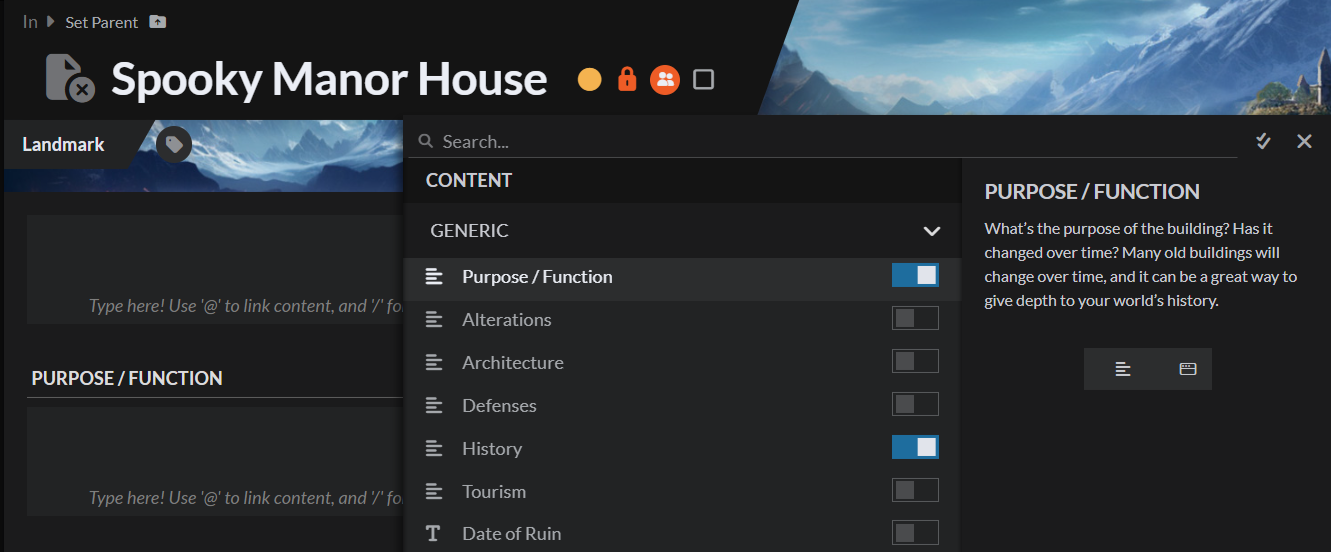
Purpose and Function
Start by asking what the building was originally built to be: a school, a manor, a mental hospital, or a temple? And what it's actually used for now. This is a great moment to establish your themes: what kind of corruption turns a place of healing, learning, or reverence into a claustrophobic prison, literally or metaphorically?
Owner and Power Hierarchy
Next, dig into one of gothic's core tenets: power and its structures. Who's actually in charge of this place? Who holds power here, and which institutions reinforce it? Remember that power doesn't always sit where it looks like it should. Consider the lurking butler, the unsettling housekeeper, the bedridden master, and play with who holds power over whom.
Content trees are a useful way to map out these power hierarchies like the dynamic between a brooding nobleman and the impoverished governess he definitely shouldn't be staring at over dinner every night, for instance. Family trees work well here too, especially for dynastic power struggles, vampire bloodlines, or generational curses.
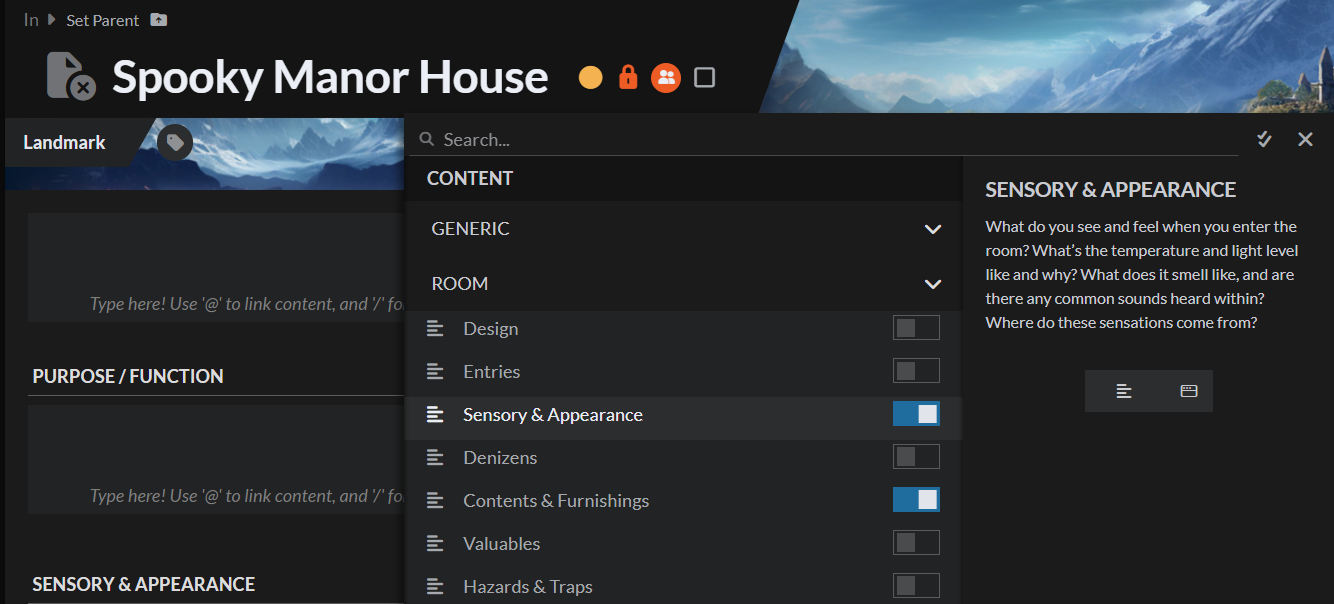
Sensory and Appearance
Tropes may be secondary to gothic's underlying engine, but they still matter enormously. What does your mansion look like, smell like, sound like, feel like? What does the air feel like? Gothic is a sensory experience, and every sense should be quietly screaming that something is wrong. That's exactly the kind of not-quite-horror tension gothic runs on.
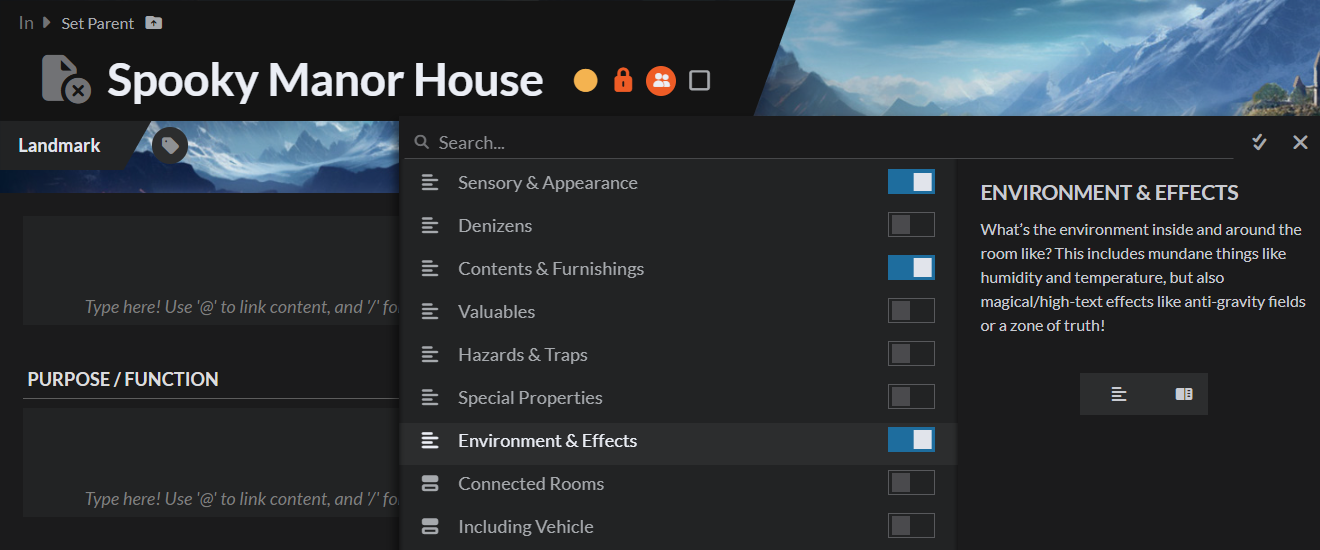
Environment and Effects
A gothic setting should feel almost alive, acting on its characters rather than simply surrounding them. Satis House in Great Expectations isn't just atmospheric backdrop; its stopped clocks and rotting wedding cake slowly turn a bitter woman and a child into ghosts long before either one dies. What does your building do to the people living inside it? Does it make them bitter? Secretive? Does it slowly drive them mad?
Bonus Prompts:
History and Architecture
For extra depth, consider your location's buried history. What happened here before the present day, and whose version of events actually survived? Every gothic location hides a shadow account beneath its official record. Your job as the worldbuilder is to know both, and to play between them the way an unreliable narrator would.
Then think about how that history is written into the physical space. What does the architecture reveal about the building's past, and how does it reinforce the mood and effects you've already established? High ceilings can make people feel small and inconsequential. Locked rooms nobody discusses reinforce a sense of secrecy. Hidden stairwells let the wealthy avoid ever having to see the servants meant to remain invisible.
Architecture carries plot potential, too. Secret passageways and hidden rooms give characters a way to spy on one another, fake supernatural events, or maintain control while hiding their true intentions. Your heroes can just as easily turn those same tools back on the villain.
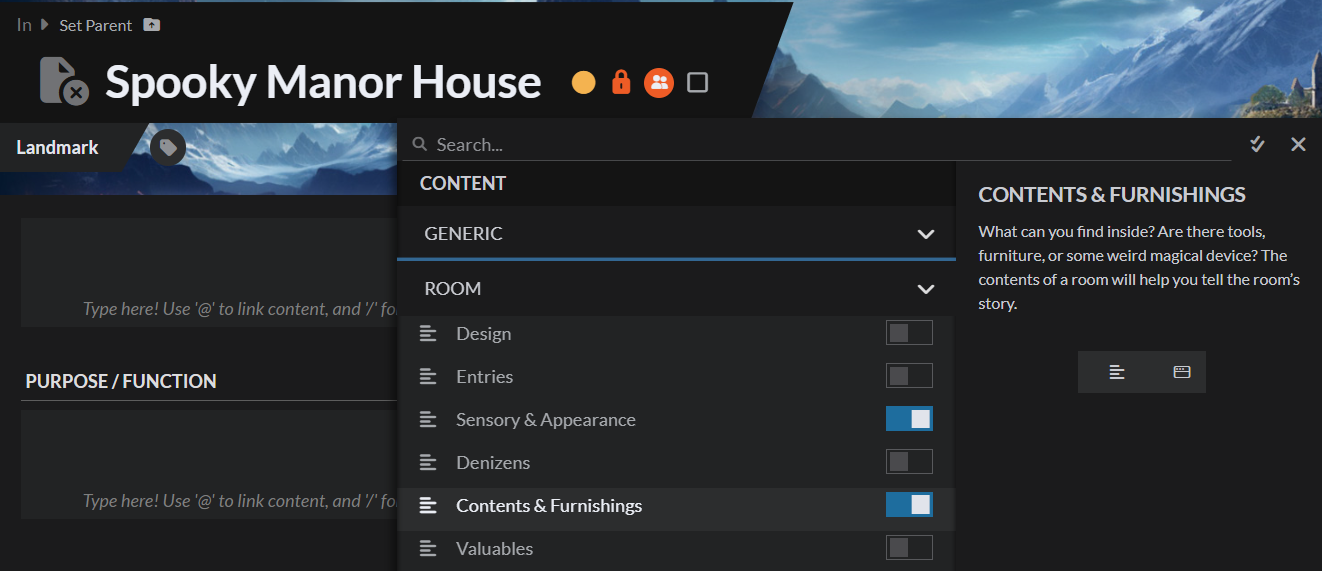
Contents and Furnishings
This thematic work extends to a room's contents as well. There's a real difference between a dining room dressed in clean white linen and one draped in tarnished brocade and fraying burgundy. What's sitting in each room, and what condition is it in? And what does that tell us about whoever controls the space? Miss Havisham kept her rotting wedding cake precisely because removing it would mean admitting time had moved on. That single detail carried enormous thematic weight, and made for one of the genre's most enduring images.
Putting It All Together
With these core tenets in hand — a monster wielding legitimate power, a corrupt institution shielding them, and a mirror maze of contradicting narratives — plus a central location to build outward from, you're equipped to do more than simply unsettle your audience. Done well, gothic worldbuilding helps readers and players face their fears, and gives them a way to explore the shadows haunting the real world too.
Now grab your (spooky) hammer, and go worldbuild!

Learn worldbuilding methods & storytelling techniques from World Anvil experts to level-up your next novel, original D&D campaign setting or other creative projects.
.png)

Popular articles

Become a World
Anvil member
.webp)